

Create a Lookup File
The methods to create lookup files are:
Create a lookup file in the Lookup files interface
You can create a new lookup file from the LogScale user interface, and then populate the content manually.
In the menu, click
Files→ .Specify a name for the file in the New file dialog.
Click : this creates a new empty table.
Click to add rows and columns to your table and start fill it in as required.
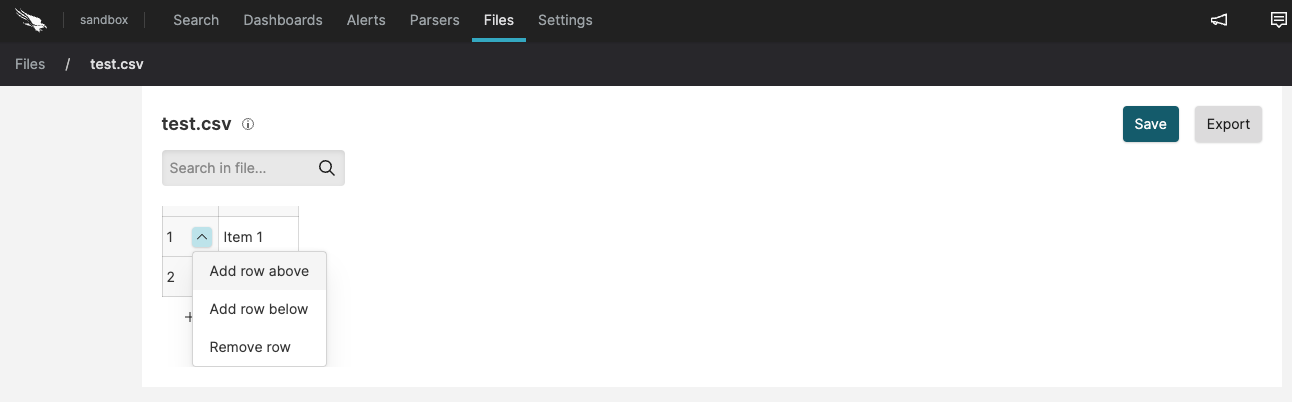
Figure 50. Create New CSV File
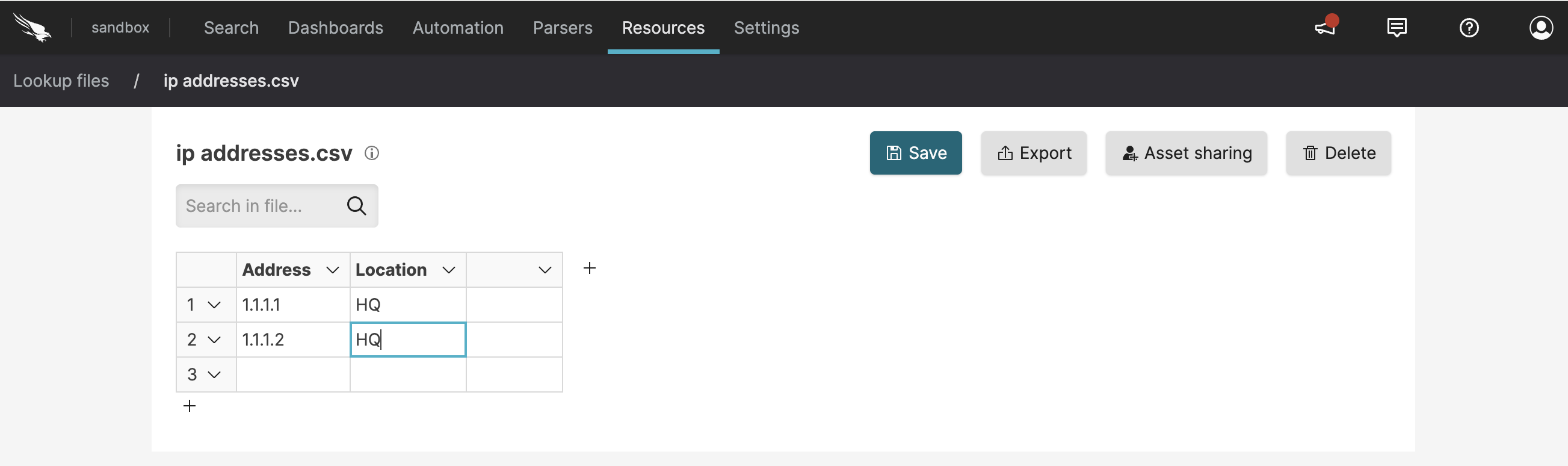
Figure 51. Create New CSV Lookup File
Click to save the changes.
If you have many changes to make, editing a data table through the
Files interface page can be tedious;
click and then
save the file to a location to edit it in a spreadsheet program or a
simple text editor.
If you have many changes to make, editing a data table through the
Lookup files page can be tedious; click
and then save the file
to a location to edit it in a spreadsheet program or a simple text
editor.
Note
Files larger than 100 MB cannot be viewed in the UI. Files with more than 1000 lines cannot be edited.
When a file is referenced in a query, a tab bearing the same name of the
file shows up in the Search page. This
file tab will display the file content as a
Table widget. Alternatively, if the file
cannot be queried, a download link will be presented instead. For
example, executing the query:
groupBy([status])

| match(file="status_codes.csv", column="code", field="status", include=name)groupBy([status])
| match(file="status_codes.csv", column="status", field=status, include=name)will show a new tab named Table: status_codes.csv:
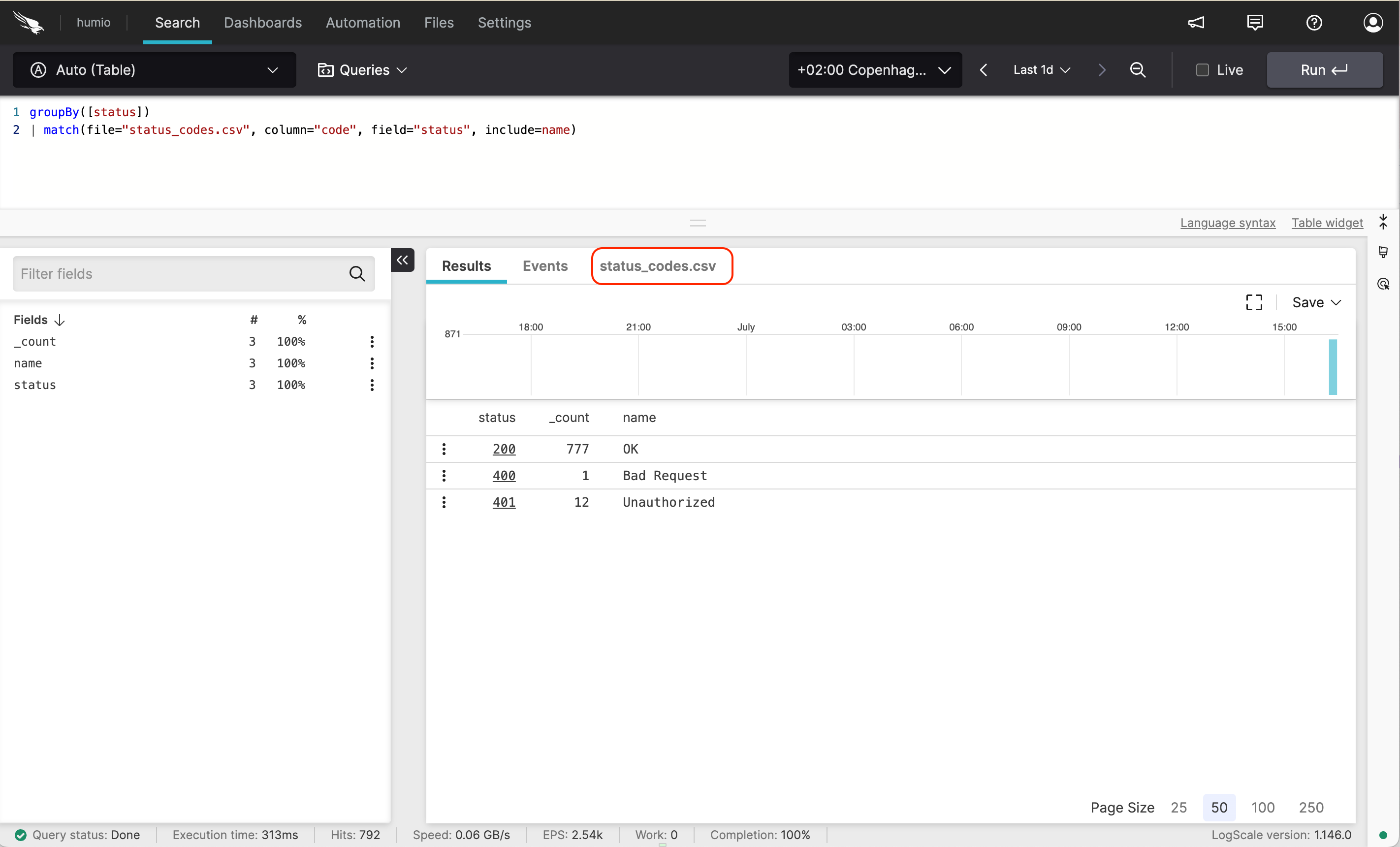 |
Figure 52. File Tab in Search View
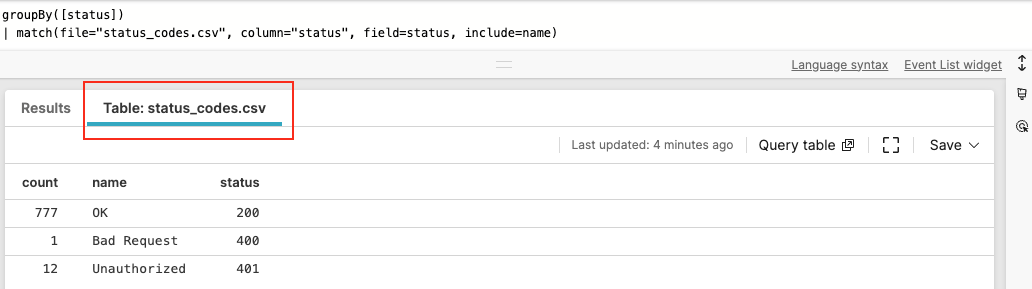 |
Figure 53. File Tab in Search View
Upload lookup files
If you created or edited a lookup file in an external system, you can upload it to LogScale.
Click the three dots next to → .

Figure 54. Import CSV File
Drag and drop your file or browse for the file to upload. You can import multiple files at once. Maximum allowed size is 209.72 MB.
You can upload a CSV file containing text like what you see below, which is essentially a lookup table that you can use for labels or value lookups.
csvuserid,ip,username,region 1,"212.12.31.23","pete","EU" 2,"212.12.31.231","bob","EU" 3,"98.12.31.21","anders","EU" 4,"121.12.31.23","jeff","US" 5,"82.12.31.23","ted","AU" 6,"62.12.31.23","annie","US" 7,"122.12.31.23","joe","CH" 8,"112.11.11.21","alice","CH" 9,"212.112.131.22","admin","RU" 10,"212.12.31.23","wendy","EU"Once it has been uploaded, it will look like what you see in Figure 55, “Import CSV File”.
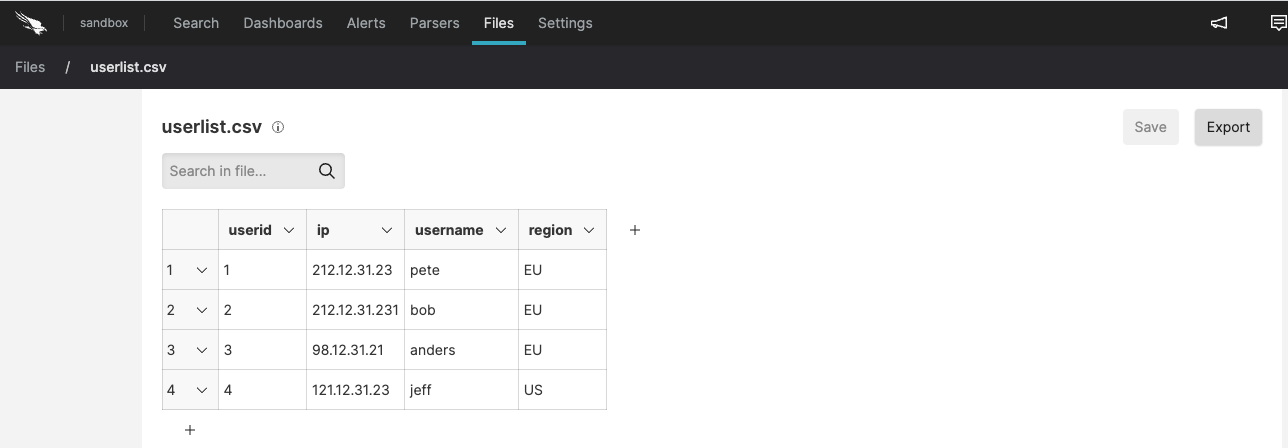
Figure 55. Import CSV File
Once it has been uploaded, it will look like what you see in Figure 56, “Import CSV File”.
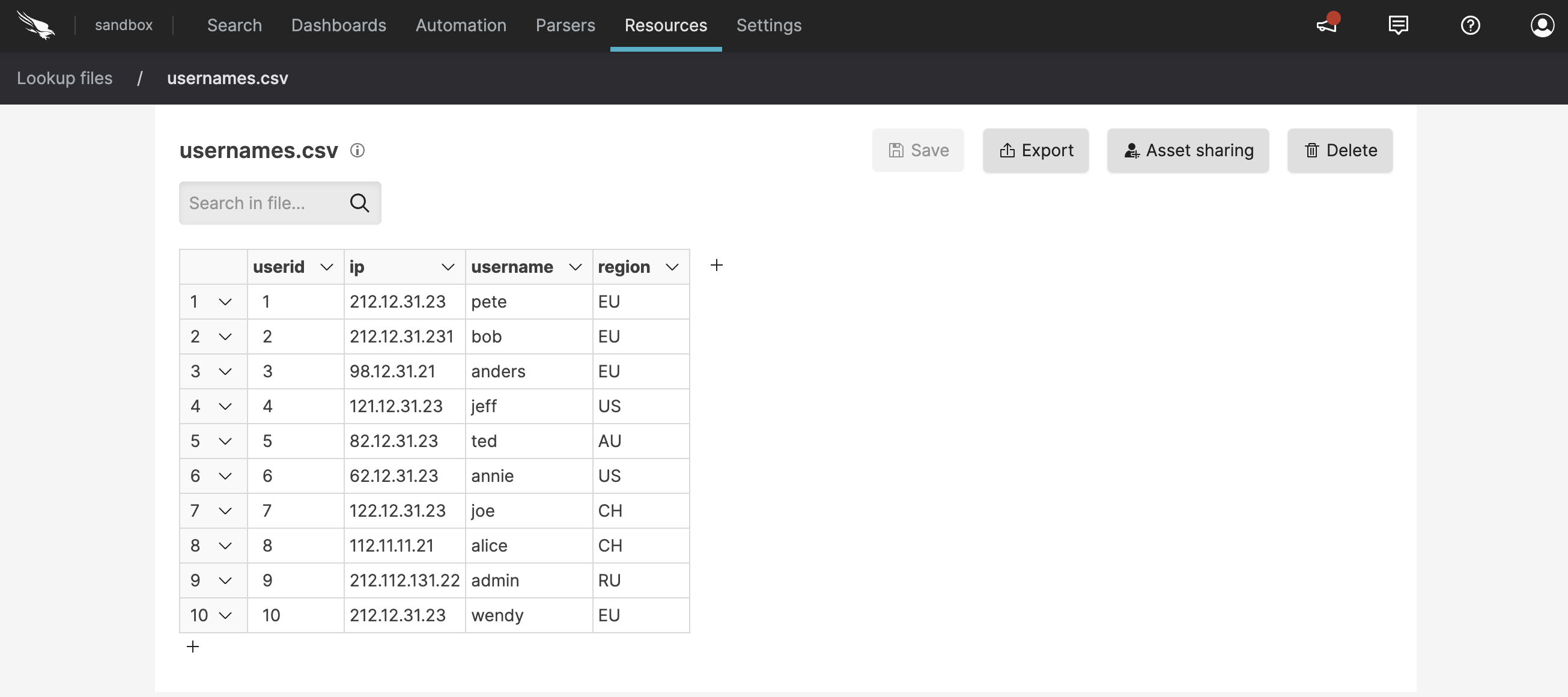
Figure 56. Import CSV File
Typically, the content is used within the
match()to lookup fixed reference information. Notice that the values are in quotes, except for the ones for userid, which are integers. See the Lookup API reference page for more information on this topic.Once created or uploaded, the file can be edited and updated within the user interface. Additional columns and rows can be added to the file using the button. Clicking the tiny information icon next to the file name displays metadata info about the file (created by, time it was created, etc.)
Important
Only CSV files can be edited once uploaded within the user interface.
Once you have finished editing, click , or click if you wish to download the edited file.
Create a lookup file through a trigger action
It is possible to create and update a lookup file with an action connected to a trigger. This means that the first time the action triggers, a lookup file will be created. And then, the lookup file will be changed on subsequent action triggers.
For more information about how to create an action that creates a lookup file, see Action Type: Upload File.